The FDA approves drugs for specific diseases, and aging is not one of them. Here is why, what the long-delayed TAME metformin trial was meant to change, and where aging-focused regulation stands in 2026.
Read the article →Independent · Evidence-graded · Sources you can check
Longevity science, explained.
Independent coverage of aging research and FDA decisions: what the studies and the regulators actually found, in plain English, with every source linked.
 Independent
 Evidence-graded
 Sources you can check
 No doses · No products
What we publish
The research, read for you and graded.
We read the studies, the FDA documents and the trial registries so that people who are not scientists can see what the evidence actually shows, in plain English, with every number traceable to its source.

Articles
Longer reads on the biology of aging and on regulatory news: fitness, sleep, NAD+, mitophagy, and what the FDA has actually decided, with every study linked.
Read the articles →
Dossiers
Evidence-graded profiles of the compounds people ask about most: what each is taken for, how it is supposed to work, and what the human research does and does not show.
Open the dossiers →
The annual report
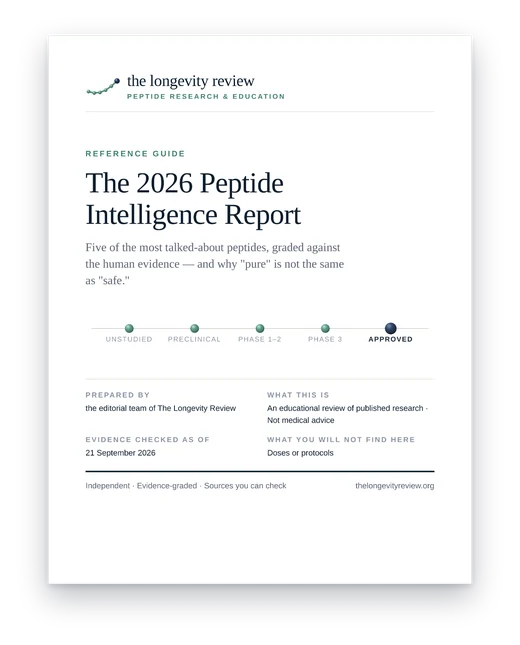
Once a year we pull the picture together. The 2026 report grades five much-discussed peptides against the human evidence and the FDA record. It is free, as a PDF.
About the free report →Latest
New from The Longevity Review
Large studies of adults consistently find that fitter people live longer. Whether raising fitness later in life extends lifespan is a separate question, and the main five-year trial in older Norwegians found no statistically significant difference in mortality.
Read the article →Deep sleep declines with age, but the idea that sleep “washes” the brain comes from mouse studies that now disagree. Here is what has been measured in mice and people, and what remains unresolved.
Read the article →How we grade
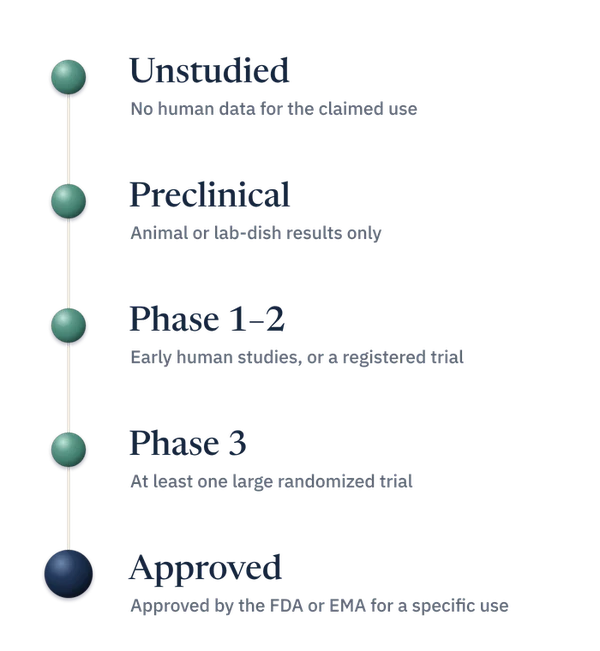
Every claim carries one of five labels.
The label describes the best human evidence for the specific use being discussed, not the compound in general and not how impressive its mechanism sounds. “It works in mice” is not the same as “it works in people,” and roughly nine out of ten drugs that look good in animals fail once they reach human trials.
Before a number appears in anything we publish, we ask five questions of the study behind it: who was it tested in, how was it designed, how many people for how long, what was measured, and where did the number come from.
The science in a nutshell
A peptide has to survive four steps before it can change anything in a living person.
- 1
It arrives
It has to get into the blood and reach the right tissue before the body breaks it down. Unmodified peptides often survive only minutes, and most fall apart in the stomach, which is why most peptide medicines cannot be taken as a pill.
- 2
It docks with a receiver
Cells carry receptors, like locks on the surface. The peptide is the key. A good fit sends a signal inside; a poor fit does nothing.
- 3
The cell passes the message along
A chain of internal switches relays the signal from the surface to the cell’s control center.
- 4
The cell changes what it does
It turns genes on or off: build more collagen, grow a new blood vessel, release a hormone. You can measure this in tissue. The real question is whether the person feels or sees a difference.
Every compound we cover has been shown to complete some of these steps in a dish or in an animal. Very few have been shown to complete all four in a living person, at a dose that helps, without causing harm. The most important word in any peptide claim is the species it was tested in, and it is the word that gets left out most often.
Dossiers
The compounds, one by one
Phase 1–2
A chain of 15 amino acids, copied from a piece of a protein found in human stomach juice.
Read the dossier →Phase 1–2
A chain of just 7 amino acids, cut from a much larger natural protein called thymosin beta-4.
Read the dossier →Phase 1–2
A three-amino-acid chain that carries a copper atom. Your blood makes it naturally, and levels fall as you age.
Read the dossier →Preclinical
A four-amino-acid chain modeled on an extract from the pineal gland, the small gland in the brain that makes melatonin.
Read the dossier →Approved
A 44-amino-acid chain that copies the body's own signal for releasing growth hormone. Sold as Egrifta.
Read the dossier →The four steps a peptide signal has to survive, and why getting through the first one is where most of them quietly fail.
Read the dossier →Manufacturing and regulation
Purity is not the same as safety.
Four of the five compounds in our 2026 report are made outside the manufacturing standards that apply to approved medicines. A typical lab certificate answers two questions about a product and says nothing about a third, which is one reason the FDA has raised quality concerns about them.
 Question 1 · Purity
How much of the product is the intended molecule?
Answered by HPLC. It shows whether broken or shortened chains are mixed in. It says nothing about germs, bacterial toxins, heavy metals or solvents. A product can test 99.5% pure and still be unsafe.
 Question 2 · Identity
Is it the molecule the label claims?
Answered by mass spectrometry. It confirms the chain was built to the right length. It cannot tell you whether the amino acids are in the right order, or what else is in the product.
Usually left out
 Question 3 · Safety
Is it free of bacterial endotoxins?
Answered only by an LAL endotoxin test, which most certificates leave out. Endotoxins can cause fever, chills and dangerous reactions, and identity and purity tests say nothing about them.
Why you can trust what you read here
Built to be checked.
These are the rules every page on this site is written under. They exist so that a reader can trust a grade without having to trust us.
Primary sources only
We cite the original paper, FDA document or trial-registry record, never a news story or a summary of one. Sources are listed at the end of every dossier and article.

Human evidence, graded
The grade describes the human evidence for the specific use discussed. Animal and lab-dish results are reported as exactly that, and every sentence about them names the species.
No doses, protocols or products
Those belong to licensed medical and pharmacy practice, not to an educational publication. When a “research” document includes them, it was usually written to sell you something.
Independent
No manufacturer or seller has any input into what we publish, and no one can pay to review, grade or feature a compound.

Dated, and corrected in place
Every dossier shows when its evidence was last checked. Grades change when new trials report, and errors are corrected on the page with a note of what changed.

Written for people who are not scientists
Plain English at roughly a tenth-grade reading level, without dumbing down the evidence and without superlatives or fear.
Free report · PDF
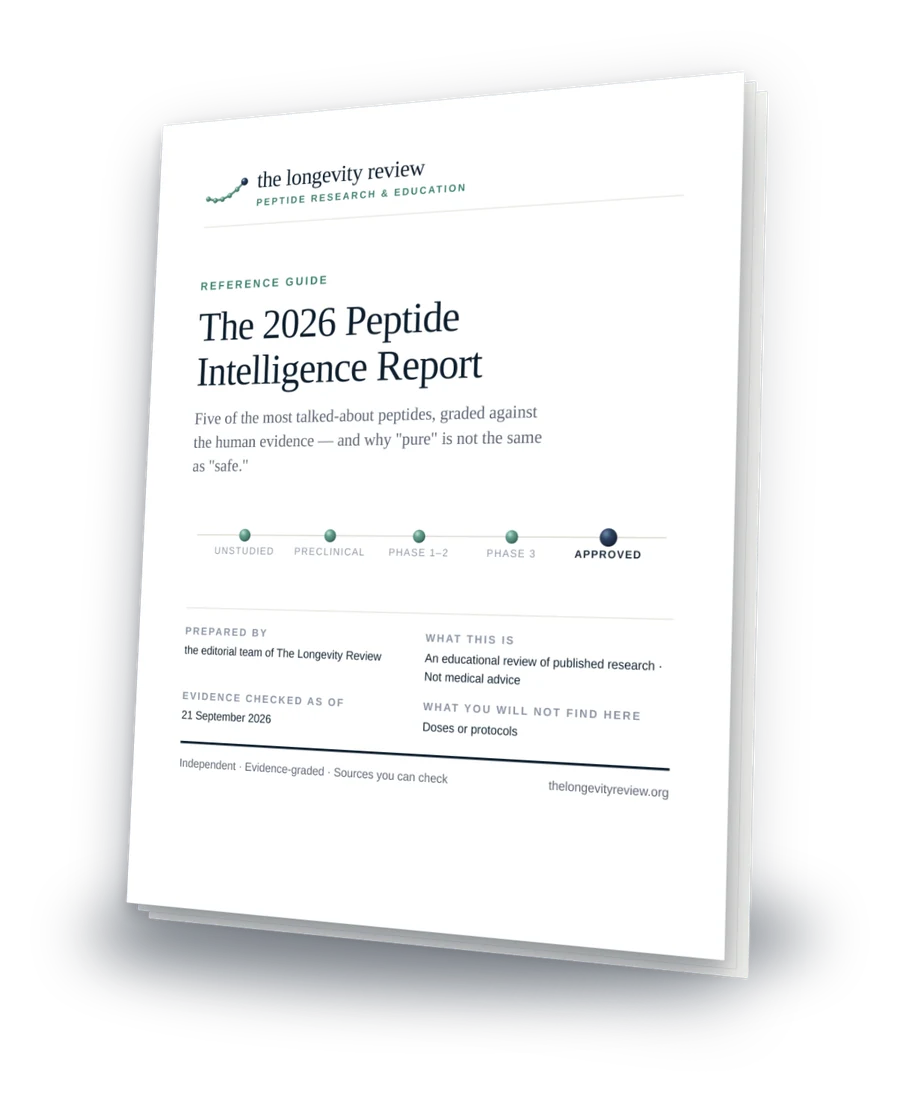
The 2026 Peptide Intelligence Report
Five of the most talked-about peptides, graded against the human evidence, and why passing a purity test is not the same as being safe.
Compiled and fact-checked from FDA briefing documents, trial registries and the original studies. It contains no doses and no protocols: what it contains is the part the forums leave out.
5compounds, graded
14primary sources
1approved for any use